A rubber cord that looks correct can still leak because its diameter, elastomer, hardness, joint, or groove does not match the service. By the end, you will be able to define the seal geometry, calculate its length, compare cord materials, and write a purchase specification that addresses pressure, temperature, fluid exposure, and installation.
Key takeaways
- Use solid cord for static joints; choose profiles for shaped or moving seals.
- Measure groove width and depth before selecting cord diameter.
- Leave the correct length for joining without buckling or gaps.
- Specify elastomer, hardness, temperature, fluids, dimensions, and inspection documents.
Match the Cord Form to the Joint and Motion
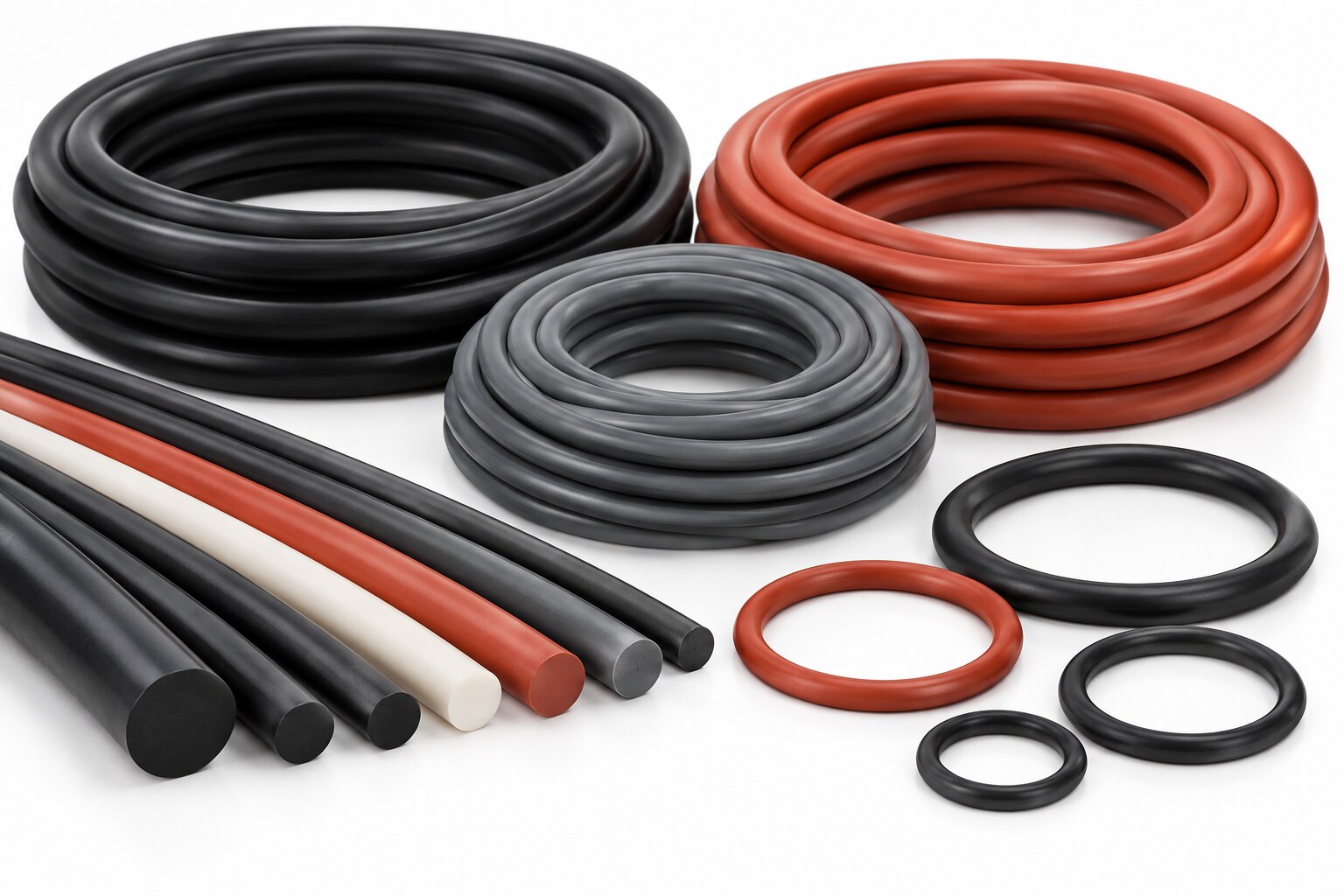
Use solid rubber cord for a static joint with a continuous groove and a defined contact pressure. It suits covers, access plates, flanges, and enclosure doors where the parts do not slide or rotate relative to each other.
| Element | Joint or motion | Main limitation |
|---|---|---|
| Solid rubber cord | Static axial or radial sealing in a regular groove | A joined section changes local hardness, strength, and surface continuity |
| Sponge cord | Low-pressure covers or doors with larger gaps and irregular surfaces | Compression set, water absorption, cell structure, and pressure resistance require separate checks |
| Molded endless O-ring | Pressure-containing static seals, rotary motion, or reciprocating motion | Requires a correctly sized standard groove and suitable elastomer |
| Extruded profile | Long covers, doors, and flanges with a shaped or asymmetric sealing path | Needs a profile-specific groove and controlled corner joints |
Sponge cord is not a softer substitute for solid cord. It compresses with less force and accommodates uneven contact, but it can collapse permanently or absorb fluid under service conditions.
Treat rubber cord joined with adhesive as a static-seal solution only after inspection and testing. For critical pressure seals or dynamic applications, specify a molded or vulcanized endless ring; an O-ring alternative made from joined cord is not equivalent.
Cord is the wrong choice when the groove has a large low-pressure clearance gap, pressure can extrude the material, or the joint moves continuously. Use a back-up ring, tighter geometry, or a molded seal instead.
Measure the Groove Before Choosing Cord Diameter
A cord cross-section should be calculated from the measured gland depth and required squeeze, not chosen because it looks slightly larger than the opening. Measure the groove at several points with a depth gauge, then record the smallest groove depth and any taper, corner radius, or damage.
- Measure the free cord diameter at several locations with a micrometer. Use the average only when the readings stay within the specified tolerance; use the largest value when checking minimum squeeze.
- Calculate squeeze as (cord diameter − gland depth) ÷ cord diameter. Rearranging gives cord diameter = gland depth ÷ (1 − target squeeze).
- Check the compression gap: the remaining distance between the seated cord and the mating face. A gap that is too small raises assembly force; a gap that is too large leaves surface defects and tolerance variation unsealed.
- Inspect the low-pressure clearance gap separately. High pressure can force soft cord into this gap, causing extrusion or nibbling.
| Application | Starting squeeze target | Main control |
|---|---|---|
| Static axial | 15–25% | Limit assembly force and avoid overfill |
| Static radial | 10–20% | Maintain contact through tolerances and compression set |
| Slow dynamic | 8–15% | Reduce friction, heat, and wear |
For example, a 2.40 mm gland depth at 15% squeeze requires a cord diameter of 2.82 mm before tolerance adjustment. Confirm the selected cord fits the groove without excessive stretch, because stretching reduces its cross-section and lowers squeeze.
Reduce the clearance gap, use harder rubber, or add a back-up ring when pressure exceeds the groove’s extrusion capability.
Calculate Length, Joining Method, and Installation Fit
Set the required rubber cord length from the groove’s finished mean diameter, not from the opening’s inside diameter alone. For a circular groove, calculate the neutral-axis circumference as:
L = π × (finished inside diameter + cord diameter)
Use the supplier’s specified allowance when cutting for a joint. Do not stretch an undersized cord until it reaches the groove; stretch reduces its cross-section and can remove the squeeze needed for sealing.
Before installation, verify these points:
- Specify the finished inside diameter and cord diameter together; a ring that is dimensionally correct in length can still fail if its cross-section is reduced by installation stretch.
- Set groove depth from the required squeeze. Excessive squeeze raises assembly force and can cause extrusion or nibbling; insufficient squeeze leaves leakage paths after tolerances and compression set consume contact.
- Fit the cord without twisting, scraping, or locally compressing it. A twist creates uneven squeeze around the circumference.
- For a critical static seal, choose a molded endless ring or a vulcanized joint rather than an adhesive joint.
- If an adhesive joint is unavoidable, require controlled surface preparation, joint alignment, cure records, visual inspection, and pressure testing. The joint has different hardness, strength, and surface continuity from the cord.
Store cut cord flat, cool, dry, and dark. Keep it away from ozone-generating equipment, UV light, incompatible chemicals, hanging loads, and tight compression that permanently distorts the section.
Choose the Elastomer and Hardness from the Service Conditions
A 70 Shore A label does not tell you whether a cord will seal your application. Select the compound from the fluid and temperature first, then choose hardness for pressure, gap, and movement.
| Compound | Suitable exposure | Main limitation |
|---|---|---|
| NBR | Mineral oils, lubricating oils, and many fuels | Limited resistance to ozone, weathering, and high-temperature service |
| EPDM | Hot water, steam, glycols, ozone, and outdoor exposure | Normally unsuitable for petroleum oils and fuels |
| Silicone rubber | Very wide high- and low-temperature range | Poorer tear, abrasion, and gas-permeation resistance |
| FKM Viton rubber cord | Many oils, fuels, and high-temperature chemicals | Not a universal choice for hot water, steam, or some amines |
For static sealing, screen compounds by compression set rather than tensile strength. ASTM D395 measures retained deformation after compression and heat exposure; compare results only when the test method and temperature match your service. A low result indicates better recovery, but it does not replace fluid-compatibility testing.
Raise hardness or reduce the low-pressure clearance gap as pressure increases. Add a back-up ring when the cord could extrude through the gap. Harder rubber resists extrusion but requires greater assembly force and may leak against rough or distorted surfaces; moving seals need a compound and hardness that limit friction, wear, and stick-slip.
Do not use a polymer’s headline temperature rating alone. Qualify the cord at the combined fluid, temperature, pressure, exposure time, and movement condition, checking swelling, low-temperature stiffening, and compression set. For gas or vacuum service, specify the gas, pressure differential, vacuum level, leak-rate limit, and allowable permeation because “chemical resistant” is not a gas-seal specification.
Turn the Design into a Verifiable Purchase Specification
Put the order on a drawing and datasheet, not in a phrase such as “70 Shore rubber cord.” State the finished diameter, cross-section, cut length or coil length, joint requirement, groove dimensions, and service medium so the supplier can verify fit rather than guess.
1. Specify diameter tolerance under ISO 3302-1 and name the selected tolerance class. Include permitted ovality if the seal relies on uniform squeeze; diameter variation changes both assembly force and leakage risk.
2. Name the compound designation, Shore A hardness and hardness tolerance, colour, and any reinforcement or lubricant restriction. Request a material certificate identifying the batch, not hardness alone.
3. Require compression set results to ASTM D395, including method, temperature, exposure time, and measured value. Do not compare results from different temperatures or test methods as though they were equivalent.
4. Define the surface acceptance criteria: continuous skin, uniform section, and no cuts, cracks, blisters, porosity, embedded debris, mould flash, or open joint. Require a sample or approved reference piece before production.
5. Request tensile strength, elongation, specific gravity, and low-temperature or fluid-compatibility data when those properties affect service. Record the test standard and conditioning for every result.
6. Check the supplier’s batch traceability, inspection report, packing date, storage conditions, and joining method. Confirm the cord was not stretched, compressed, exposed to ozone or sunlight, or stored near incompatible chemicals.
If requesting a sealing item from Kanta Enterprises, send this drawing and acceptance checklist with the enquiry; it prevents a hose, sheet strip, or unverified cord from being quoted as an interchangeable part.
Frequently asked questions
Which rubber cord form suits an industrial joint?
Use solid rubber cord for static joints with continuous grooves, such as covers, access plates, flanges, and enclosure doors. Choose a different profile when the seal must follow a complex section or accommodate movement.
How do you select rubber cord diameter?
Measure the groove width and depth, then select a cord diameter that creates controlled compression without bottoming out, excessive force, or extrusion. Confirm the design against the groove geometry and joint gap.
How do you calculate rubber cord length and join it?
Measure the groove path, account for the joint design, and cut the cord cleanly so the finished loop fits without a gap, overlap, buckling, or excessive stretch. Use a suitable adhesive or vulcanised joint when the specification requires it.
How do you choose rubber cord elastomer and hardness?
Base the choice on operating temperature, contacted fluids, ozone and weather exposure, pressure, and movement. Select hardness to provide sealing contact without making assembly force or extrusion unacceptable.
What should a rubber cord purchase specification include?
State the cord form, cross-section or diameter, elastomer, hardness, temperature range, fluid compatibility, required length, joint method, tolerances, batch identification, and inspection or conformity documents.