A pneumatic tube must route air through a moving machine without kinking, leaking, wearing through, or creating excessive pressure loss. By comparing polyurethane with nylon, polyethylene, PVC, and rubber hose, then checking material grade, dimensions, temperature, pressure, flow, and environment, you can decide when PU is the practical choice and when another tube is safer.
Key takeaways
- Match PU grade to oil, water, chemicals, and outdoor exposure.
- Check tube outside diameter, wall thickness, pressure, bend radius, and airflow needs.
- Use reinforced construction when pressure, abrasion, or mechanical loads demand it.
- Select colours that make pneumatic circuits easier to trace and maintain.
Why polyurethane balances the demands of automated machines
PU tube is common in automated machines because it combines flexibility, kink resistance, abrasion resistance, and adequate pneumatic pressure capability without adding much weight. Polyurethane tubing bends around compact frames, valve islands, grippers, and moving robot axes, reducing the space needed for air routing.
Its value comes from the balance rather than a single maximum rating:
- Flexibility allows repeated movement in cable carriers, robot dress packs, and actuator assemblies.
- A small bend radius supports tight layouts, but you must follow the manufacturer’s limit near push-in fittings.
- Abrasion resistance helps the tube survive sliding contact better than ordinary PVC.
- Compatibility with standard push-in fittings speeds installation and replacement.
- Low weight places less load on moving machine parts than a rubber hose.
| Material | Strength in pneumatic routing | Limitation |
|---|---|---|
| PU | Flexible, light, abrasion-resistant | Lower temperature and pressure capability than specialist tubing |
| Nylon | Stiffer, dimensionally stable | Less suitable for repeated tight flexing |
| Fluoropolymer | Chemical and temperature resistance | Higher cost and less forgiving routing |
| Rubber hose | Tough and flexible in larger sizes | Bulkier for compact automation |
| PVC | Low-cost general routing | Weaker abrasion and flexing performance |
PU is not immune to damage: a sharp metal edge can wear through it after repeated contact, and a kink near a fitting can create leaks or restrict airflow. Select a UV-rated formulation or protect the route outdoors; aromatic polyurethane can degrade in sunlight, while aliphatic grades provide better UV stability.
How PU tube carries air through a pneumatic circuit
Air leaves the compressor and passes through the FRL unit, which filters particles, removes moisture, and regulates supply pressure. The prepared air then travels through PU tube to the directional control valve.
When the valve shifts, it sends air through a tube connected to one actuator port while exhausting the opposite side. The actuator converts that pressure into linear or rotary movement.
Push-in fittings create the sealed transition between the tube and each component; the tube’s inside diameter determines how much air reaches the actuator and how much pressure is lost along the route.
Install every connection so the tube remains round, clean, and fully supported:
- Cut the tube square with a sharp cutter. A diagonal or crushed end can prevent the internal seal from closing.
- Push the tube completely to the fitting stop, then pull lightly to confirm that the collet has retained it.
- Keep scratches, burrs, and oval sections away from the sealing area. Release the collet before removing tube; pulling it out directly can damage the surface.
- Respect the specified minimum bend radius. A tight bend beside a fitting can kink the bore, impose side load, and cause a leak.
- Clip long runs and support heavy or vibrating sections near each fitting. Flexibility helps moving assemblies, but unsupported tube can pull on connections.
Check the tube-and-fitting working-pressure rating at the actual temperature; a burst-pressure figure alone does not make pneumatic PU tube suitable for hydraulic service.
Choose the PU grade for oil, water, chemicals, and outdoor exposure
Choose ester-based PU when oil resistance and fuel contact matter most. Choose ether-based PU for wet service, water exposure, or repeated condensation, where hydrolysis resistance prevents the tube from softening and cracking.
| Grade | Main advantage | Choose it when |
|---|---|---|
| Ester-based PU | Better oil resistance and fuel compatibility | Lubricated machinery, oil mist, or fuel contact is expected |
| Ether-based PU | Better hydrolysis resistance | Water, humidity, condensation, or prolonged wet service is expected |
| Aliphatic or UV-rated PU | Better colour and ultraviolet stability | The tube runs in continuous sunlight or outdoor equipment |
Neither grade is universally chemical-proof. Strong acids, strong bases, aromatic solvents, aggressive cleaners, and concentrated oxidizers require a compatibility check using the exact fluid, concentration, temperature, and exposure time. Hot, wet service is especially hard on ester-based PU; ether-based PU handles hydrolysis better but still needs a temperature and chemical limit from the manufacturer.
Treat temperature as a selection variable, not an afterthought: heat reduces pressure capability and speeds chemical attack. Standard aromatic PU can discolour and degrade in sunlight, so use UV-rated or aliphatic material, or route it under cover. Keep ordinary PU away from sparks and hot surfaces unless its flame rating permits that installation.
PU is normally electrically insulating; combustible dust, solvent vapour, sensitive electronics, or high-speed conveying may require dissipative or conductive tubing to control static electricity.
Specify dimensions, pressure, bend radius, and flow before ordering
An 8 mm outside diameter tube is not automatically an 8 mm air passage. Check the inside diameter because it, along with tube length, operating pressure, valve orifice, fitting bore, and required actuator speed, determines airflow and pressure drop. Specify the actual flow requirement and allowable pressure loss before choosing a size.
| Check | What to specify | What goes wrong if ignored |
|---|---|---|
| Outside and inside diameter | Tube size plus required airflow at operating pressure | A small inside diameter starves a fast cylinder even when the outside dimension fits the fitting |
| Working pressure | Rating at the highest operating temperature, with derating confirmed | Heat can push the tube beyond its safe limit |
| Burst pressure | Manufacturer’s value for the exact tube construction | Burst pressure is not a usable operating pressure or a hydraulic-service rating |
| Minimum bend radius | Radius during installation and repeated movement | A tight bend kinks the bore, stresses the fitting, and creates leaks |
| Length and routing | Shortest practical route, supported away from sharp edges and heat | Extra length and restrictive bends increase pressure loss and response time |
Use the tube/fitting combination named by the manufacturer. Cut the tube square, keep its surface free of scratches and ovality, and insert it fully to the fitting stop; bending immediately at a push-in fitting can defeat the seal. Do not select pneumatic PU tube for hydraulic pressure merely because its burst pressure looks sufficient.
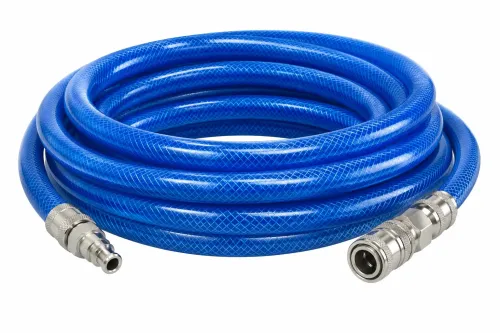
Kanta Enterprises is a useful distinction to keep in mind when your application actually needs an oil, water, or high-pressure transfer hose rather than instrumentation tubing.
Use tube construction and colour to improve machine reliability
A push-in fitting seals against a clean, round tube surface, so tube hardness directly affects insertion, grip, and sealing. Very soft PU can deform under the collet or collapse under side load; very hard tube resists crushing but needs more insertion force.
Wall thickness improves crushing resistance and pressure capability, yet reduces flexibility and increases the minimum bend radius.
- Cut the tube square, remove burrs, and push it fully to the fitting stop. A slanted cut or incomplete insertion creates a leak.
- Keep bends outside the fitting’s minimum bend radius. Bending immediately at the collet can ovalise the tube and overload the seal.
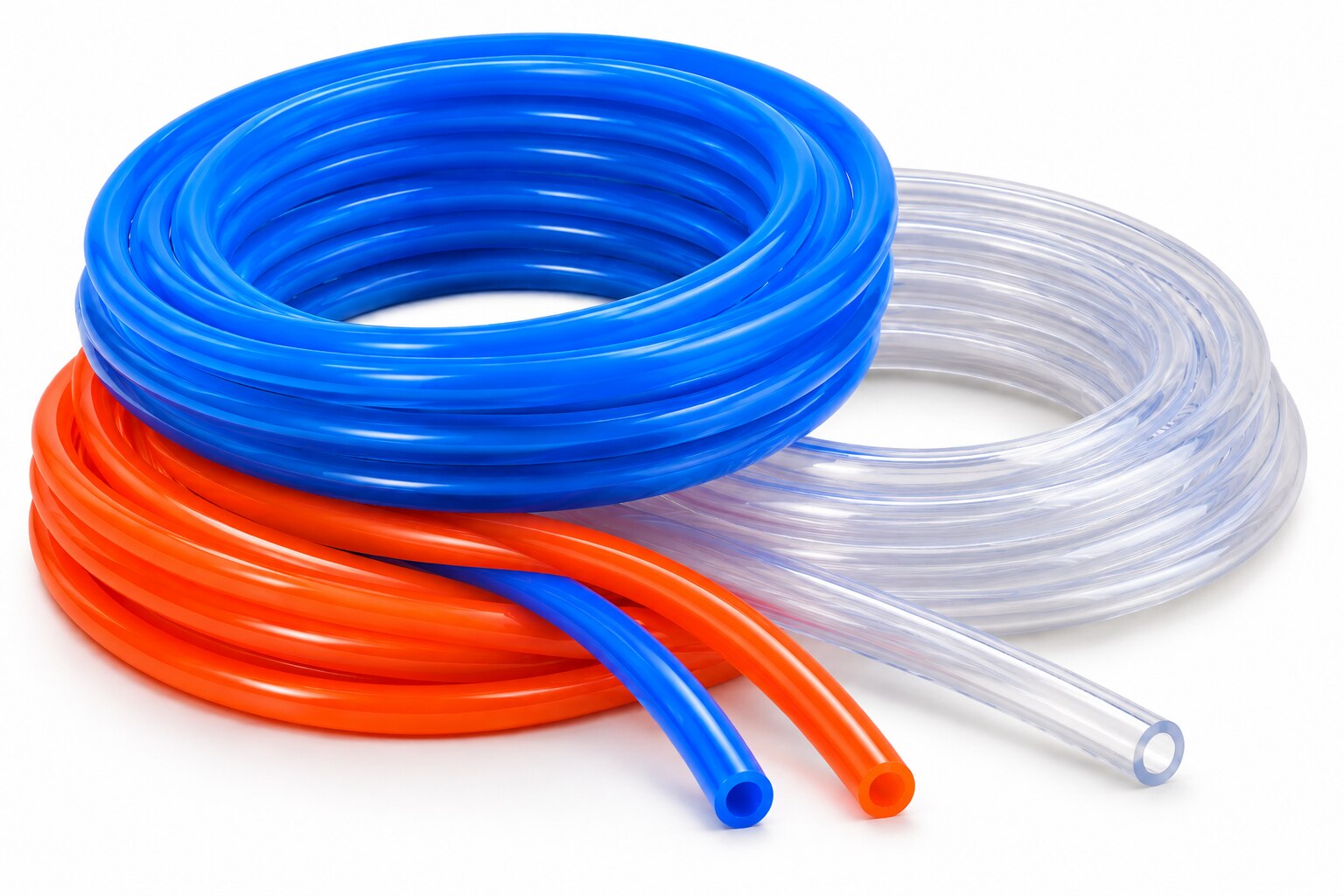
- Use tube colour and printed marking to identify supply, exhaust, vacuum, or actuator lines during maintenance. Colour does not prove the polymer grade, pressure rating, or temperature range.
- Read the marking for outside diameter, wall thickness, material, working pressure, and temperature limits. Confirm the rating at the actual temperature.
| Option | Strengths | Choose it when |
|---|---|---|
| PU tube | Flexible, abrasion-resistant, light, compact, and suited to repeated movement | Routing space and flexing matter more than maximum pressure or temperature |
| Nylon | Stiffer, dimensionally stable, and less permeable | Fixed runs, higher dimensional stability, or lower air loss matter |
| Fluoropolymer | Strong chemical and temperature resistance | Aggressive chemicals or elevated temperature control the decision |
| Rubber hose | Handles vibration and large movement with thick, compliant walls | Shock, vibration, or high flow outweighs compact routing |
Choose PU when its flexibility, fitting compatibility, and abrasion resistance solve the routing problem—not simply because it is soft or colourful.
Frequently asked questions
Why is PU tube widely used in pneumatic automation systems?
PU tube combines flexibility, kink resistance, abrasion resistance, low weight, and adequate pressure capability for compact automated machinery.
How does PU tube carry air through a pneumatic circuit?
It routes compressed air between the supply, valves, actuators, grippers, and other components while bending around machine frames and moving axes.
How do you choose a PU tube grade for different environments?
Match the grade and construction to exposure from oil, water, chemicals, sunlight, temperature changes, and abrasion.
Which PU tube dimensions and specifications should you confirm before ordering?
Confirm the outside diameter, inside diameter, wall thickness, working pressure, temperature range, bend radius, and required airflow.
How do tube construction and colour improve pneumatic machine reliability?
The right construction resists pressure and mechanical damage, while colour coding helps you identify circuits and troubleshoot connections faster.