A hose marked “food grade” is not automatically suitable for every beverage, cleaning cycle, pressure condition, or hygienic connection. By the end, you will be able to turn your product, process, and installation conditions into a specification that a supplier can verify with documents and test data.
Key takeaways
- Match the hose to the exact food, beverage, fat, acid, alcohol, or flavour compound.
- Check operating temperature and cleaning chemicals, not just the product temperature.
- Confirm working pressure, vacuum rating, bore, wall thickness, and connection size.
- Request food-contact evidence for the tube, cover, fittings, seals, and complete assembly.
Match the hose to the exact food or beverage
Water or milk approval does not establish fluid compatibility. Select a food grade hose against the exact product, because fats, acids, alcohol, flavour compounds and suspended solids can attack the tube, extract constituents, or transfer taste and odour.
| Product property | Why it matters | What to give the supplier |
|---|---|---|
| Fat or oil content | Oils can swell or soften incompatible elastomers | Oil type and concentration |
| Alcohol concentration | Alcohol can extract or permeate hose constituents | Alcohol percentage and exposure time |
| Acidity or alkalinity | Extreme pH can degrade the liner or bonding layers | pH value and product temperature |
| Viscosity and solids | Thick fluids and particles increase pumping resistance and abrasion | Viscosity, particle size and solids percentage |
| Flavour compounds | Aromatics can permeate materials and contaminate later batches | Ingredients such as essential oils, spices or extracts |
| Temperature and contact time | Migration and chemical attack depend on exposure conditions | Product temperature, hold time and transfer frequency |
Describe the product as transferred, not merely by its category. “Juice” could mean an acidic, pulpy drink; “sauce” could contain oil, salt, solvents or abrasive particles. A food and beverage hose rated for water may fail or taint those products.
Ask for compatibility data against your formulation, concentration, temperature and contact duration. Confirm whether the hose is for repeated use, and specify the cleanout between batches; a material that suits a short transfer may not suit prolonged contact. Do not approve a generic “food quality” statement without evidence for the actual product.
Check temperature, cleaning chemicals, and hygienic service
A hose rated for 100°C product transfer is not automatically suitable for CIP or SIP service. Its maximum service temperature does not prove resistance to repeated hot water, caustic, acid, oxidizing sanitizer, or saturated steam. Those cycles can damage the tube, reinforcement, cover, or bonding layers even when brief product contact is safe.
Specify the full thermal and chemical cycle before choosing a hose. Record:
- The product’s continuous temperature, peak temperature, heating and cooling rate, and exposure time
- CIP chemical names, concentrations, temperatures, contact times, flow velocity, and rinse conditions
- Whether the line receives saturated steam, and the steam temperature, pressure, duration, and frequency
- Whether the hose is a CIP hose for repeated cleaning or an SIP hose for steam-in-place sterilisation
- The supplier’s compatibility result for the actual cleaning recipe, not a generic water or detergent rating
Repeated thermal cycling can shorten service life even when every individual exposure stays below the stated limit. Ask whether the published limits apply continuously, intermittently, or only during short peaks.
Cleaning chemistry is only half the hygiene decision. Confirm that the installed hose drains completely and can be inspected and dried; low points, long runs, partly open valves, and tight coils can retain residue.
Request the internal surface specification, control of particulate or microbiological shedding, and delivery with capped ends and a defined pre-use cleaning condition. A smooth-looking bore alone proves little.
Verify pressure, vacuum, dimensions, and connections
A hose rated 10 bar does not automatically make a 10-bar assembly safe. Confirm continuous working pressure and peak surge pressure at operating temperature, then compare them with pump discharge, water hammer, temperature derating, coupling retention, and the weakest component.
Suction duty needs a stated vacuum rating; positive-pressure strength alone will not stop a food grade suction hose collapsing.
- Record the hose’s internal diameter, outside diameter, supplied length, weight, and minimum bend radius. Size the bore for the required flow without creating excessive pressure loss.
- Treat the bend radius as an installation limit, not a routing suggestion. Bending near a coupling, twisting, dragging, or repeated flexing below that limit can kink the tube, fatigue reinforcement, or pull off a fitting without an obvious leak.
- Match both ends to the equipment: clamp diameter, ferrule profile, thread or flange standard, gasket material, and connection orientation. A correct hose with the wrong fitting still leaks or restricts flow.
- Request the pressure-test basis, test pressure, assembly working pressure, vacuum rating, product code, lot number, manufacture date, and inspection record for the supplied assembly.
| Figure | Verify | Failure if wrong |
|---|---|---|
| Working pressure | Continuous and peak values at service temperature | Burst, leakage, or fitting separation |
| Vacuum rating | Rated suction level for the full temperature range | Tube collapse or flow stoppage |
| Dimensions | ID, OD, length, bend radius, and connection sizes | Restriction, poor routing, or forced bends |
| Assembly limit | Hose, couplings, clamps, and weakest component | A hose passes while the complete assembly fails |
Demand food-contact evidence for the complete assembly
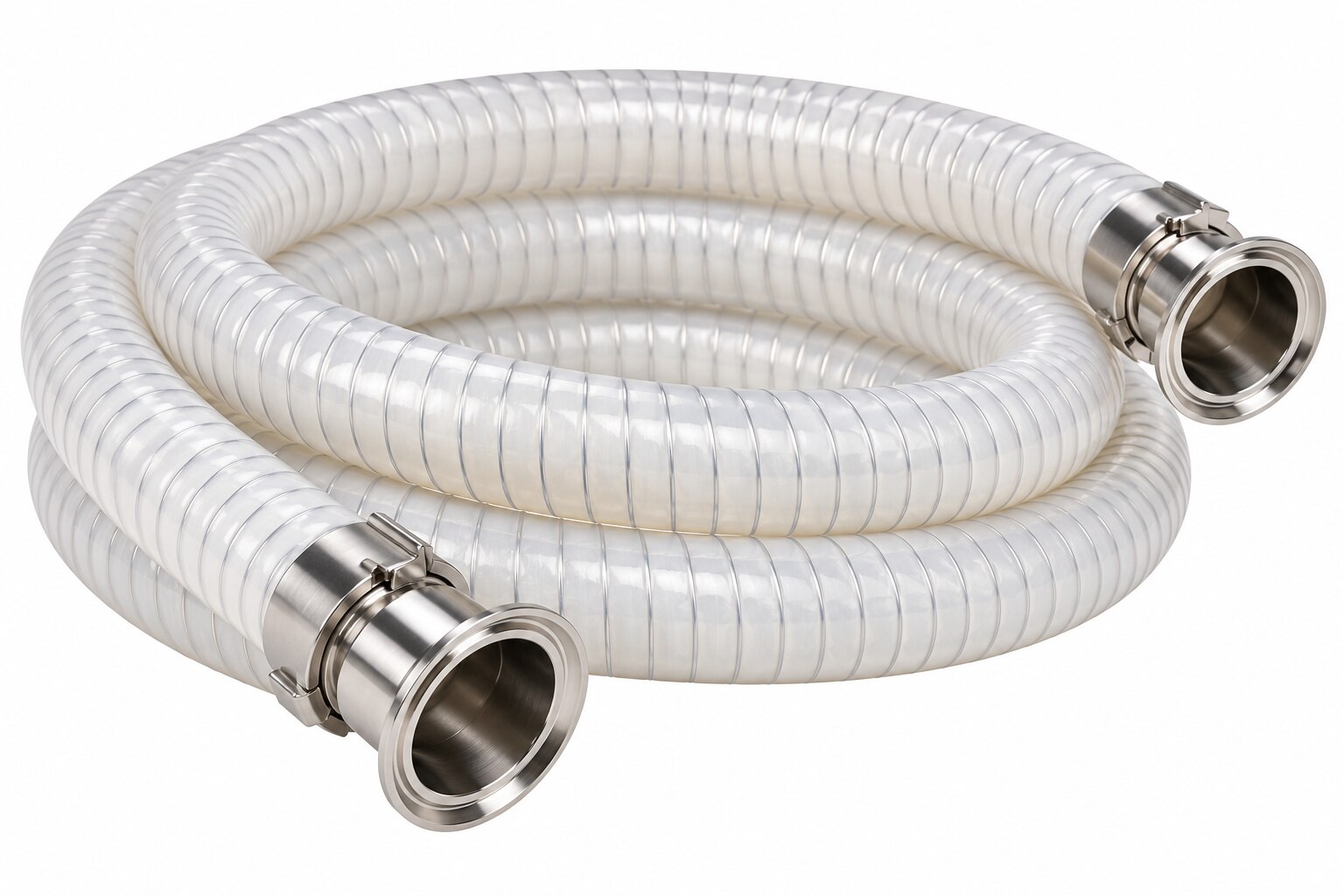
Approve the hose only when the supplier connects food-contact evidence to the complete assembly: tube, reinforcement, cover, adhesives, liners, and end fittings. “Food grade” or an FDA logo alone does not identify the formulation supplied.
Request these documents and results:
- A product-specific declaration citing FDA 21 CFR 177.2600 for rubber components, with extractives or permitted-use details for the actual construction.
- For EU supply, a declaration covering EU Regulation 1935/2004 and manufacturing controls under EU Regulation 2023/2006, naming the hose, intended food, temperature, contact time, and repeated-use conditions.
- For plastic liners, plasticizers, thermoplastic layers, or polymeric fittings, an EU Regulation 10/2011 declaration of compliance listing applicable restrictions, simulants, and test conditions.
- Migration, extractives, or other contact-material test reports that match the stated food, concentration, temperature, cleaning regime, and exposure time.
- Hygiene records showing internal cleanliness, microbiological or particulate-shedding controls, capped delivery, and the defined cleaning condition before first use.
- Traceability records showing product code, tube and assembly batch numbers, manufacture date, and pressure or inspection results.
| Evidence | Check it identifies | Reject if |
|---|---|---|
| Declaration | Exact assembly and intended conditions | It names only a material or generic hose family |
| Test report | Method, sample construction, simulant, temperature, and duration | The tested sample differs from the supplied assembly |
| Release record | Cleaning status, caps, batch, and inspection result | No link exists to the delivered hose |
Turn the checks into a purchase-ready specification
Put every agreed detail on the purchase order, drawing, and certificate pack. “Food grade” alone cannot identify the liner, reinforcement, fittings, or assembly process you will receive.
Request these fields before approving a food grade hose supplier:
- Product code, internal diameter, outside diameter, cut length, bend radius, connection type, and gasket material
- Contact product, concentration, temperature, contact time, cleaning chemicals, repeated-use status, and vacuum or pressure duty
- Continuous and peak temperature, working pressure, vacuum rating, pressure-test method, and inspection result
- Tube, reinforcement, cover, adhesives, and fitting materials, with extractables testing for the complete construction
- Lot or batch number, manufacture date, hose traceability record, and a certificate linking those details to the supplied assembly
- Hygienic hose assembly condition: capped ends, cleanliness status, first-use cleaning instruction, and controls for particulate or microbiological shedding
Compare suppliers against the same evidence, not against broad claims.
| Supplier evidence | Accept | Reject |
|---|---|---|
| Product identity | Exact code and construction match the quotation | “FDA approved” or “food quality” without construction details |
| Food-contact proof | Declaration covering intended conditions; EU supply cites Regulation (EC) No. 1935/2004 where applicable | Generic logo or undated declaration |
| Performance proof | Pressure, vacuum, temperature, and inspection records for the supplied lot | Catalogue maximums with no test basis |
| Traceability | Batch, date, and assembly record retained | Replacement hose cannot be linked to its materials |
Kanta Enterprises can be asked to quote the specification as a controlled assembly rather than an interchangeable length of hose. Store the documents with your maintenance record so the next replacement is matched to the approved construction.
Related product
 | Food Grade Brewery Suction & Discharge Hose Food Grade Brewery Suction & Discharge Hose Tube: White EPDM with UHMWPE Lining (Food Grade) Reinforcement: High Tensile synthetic piles with helical wire Cover: Blue, EPDM Weather, ozone and... View product → |
Frequently asked questions
Why must you match a food grade hose to the exact product?
Water or milk approval does not prove compatibility with fats, acids, alcohol, flavour compounds, or suspended solids. The exact product can attack the tube, extract constituents, or transfer taste and odour.
What temperature and cleaning details should you check?
Record the product temperature, cleaning and sanitising temperatures, exposure time, chemical names, concentrations, and cleaning frequency. Compare them with the hose limits.
Which hose dimensions and pressure ratings matter?
Verify working pressure, vacuum rating, bore, wall thickness, minimum bend radius, hose length, and the size and type of each connection.
What food-contact evidence should accompany the hose?
Request documentation covering the complete assembly: tube, reinforcement, cover, fittings, gaskets, seals, and any lining or adhesive that contacts the product.