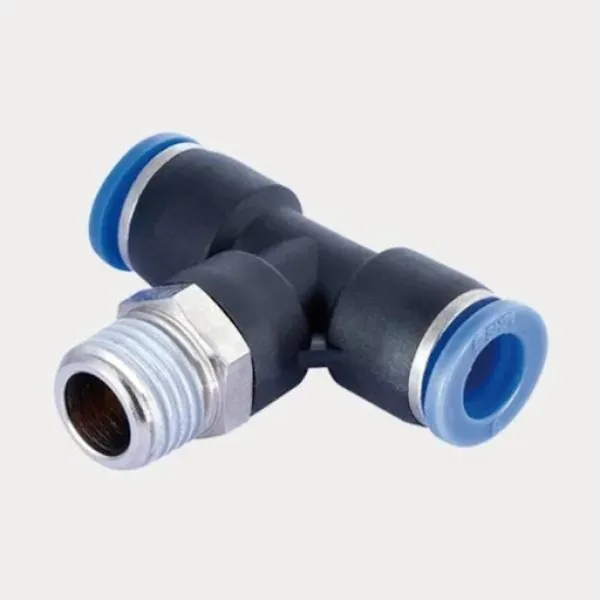
Production equipment increasingly relies on compact pneumatic circuits that must be easy to install and service. Push Fittings are commonly considered for these systems because they can provide a practical method of connecting compatible pneumatic tubing without unnecessarily complicated assembly procedures.
For OEMs, automation companies and maintenance teams in Nagpur, selecting the right fitting requires more than identifying the number of connection ports.
Begin with tube size
Tube outside diameter is a fundamental selection parameter. The fitting must be designed for the exact tubing dimensions being used.
Procurement teams should avoid approximating tube size by visual inspection. Accurate identification is especially important when a facility uses several similar tubing sizes on different machines.
Identify the required fitting configuration
Pneumatic layouts may require straight connections, elbows, tees, reducers and other configurations depending on equipment design.
The right configuration can improve routing and reduce unnecessary tube bending.
Before ordering, check:
- Tube dimensions
- Port thread
- Fitting configuration
- Working pressure
- Operating temperature
- Medium
- Available installation space
This simple checklist can prevent many incorrect purchases.
Material should suit the environment
Industrial environments differ significantly. A fitting installed inside clean automation equipment experiences different conditions from one exposed to dust, moisture, chemicals or demanding temperatures.
The fitting body and sealing materials should therefore be appropriate for the intended service conditions.
Installation quality still matters
Push connection technology simplifies assembly, but technicians still need to prepare tubing correctly.
Tube ends should be clean and properly cut. Damaged, distorted or poorly cut tubing can affect sealing.
The tube should also be inserted according to the fitting design. After assembly, technicians should verify the connection and inspect the circuit for leakage under the appropriate operating procedure.
Maintenance accessibility can influence selection
Machine designers should consider how easily technicians can reach pneumatic connections.
A compact fitting is useful only when maintenance personnel can release and reconnect tubing without dismantling unrelated machine components.
Thoughtful fitting placement can reduce servicing time during routine maintenance.
Standardisation helps OEM procurement
Engineering companies building multiple machines can benefit from standardising common tubing sizes and fitting configurations where the equipment design permits.
Standardisation can simplify inventory, reduce procurement complexity and make field servicing more predictable.
For OEMs and manufacturing facilities across Maharashtra, this can be particularly useful when machines are installed at multiple customer sites.
Kanta Enterprises in Nagpur supplies pneumatic and industrial fluid handling components for different engineering requirements. Buyers evaluating Push Fittings can provide tube dimensions, thread details, configuration and operating conditions to make product identification more accurate.
Readiness to purchase should come after these specifications are confirmed. When size, thread, environment and system requirements are clearly documented, buyers can compare available fittings more effectively and avoid selecting connectors simply because they look similar to existing parts.
Keywords